
Digital ads for small business leads in Kent in 2026
- Blue Moxie
- 5 days ago
- 8 min read

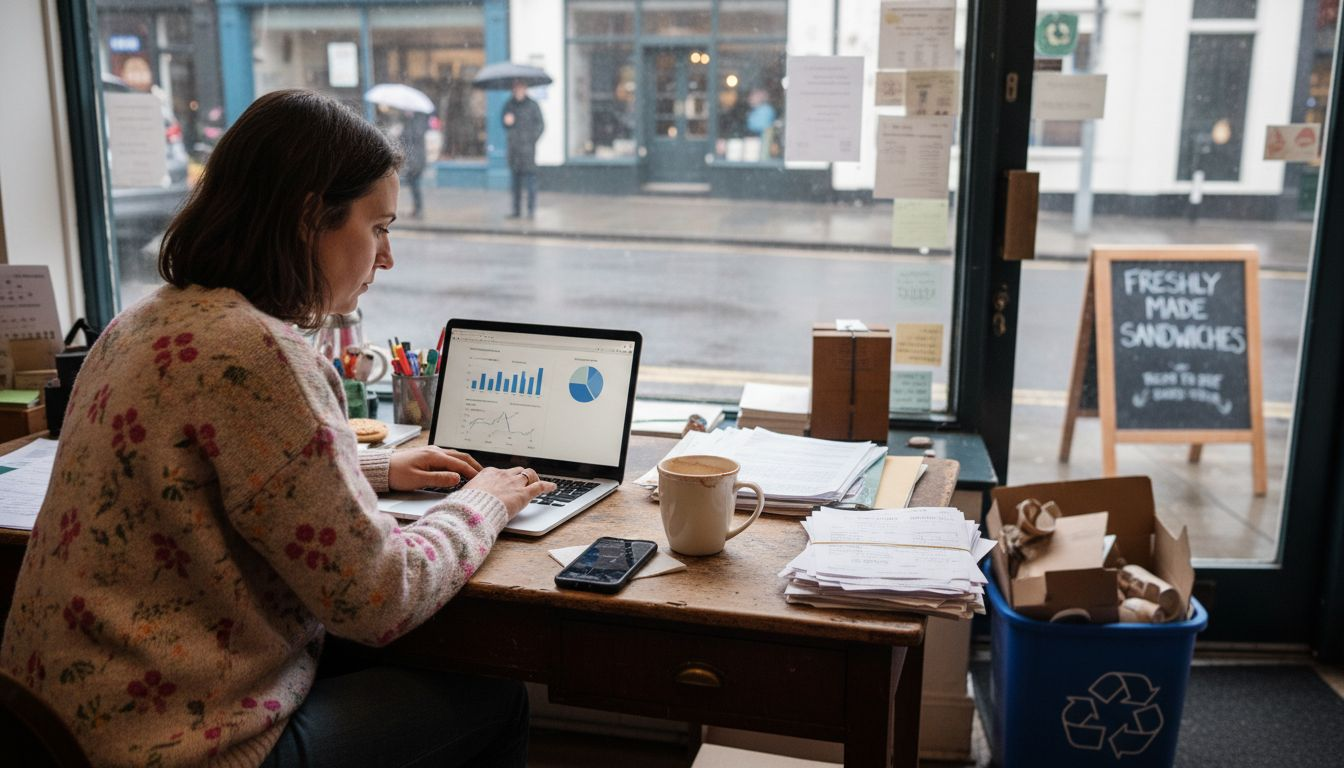
Many Kent business owners believe digital advertising requires massive budgets or complex technical expertise. That misconception costs them valuable leads every day. Digital ads, particularly pay-per-click campaigns, deliver immediate visibility and measurable results for businesses of any size. You control spending, target local customers precisely, and track every pound invested. This guide reveals practical strategies Kent SMBs use to generate qualified leads through digital advertising, avoid costly mistakes, and leverage modern tools like AI to maximise returns without expanding your marketing team.
Table of Contents
Key takeaways
Point | Details |
Immediate local visibility | Digital ads place your Kent business directly in front of customers actively searching for your services right now |
Budget control matters | Pay-per-click models ensure you only spend when potential customers engage with your ads |
Avoid common traps | Broad targeting and poor landing pages waste budget while conversion tracking reveals what actually works |
Advanced tactics win | Long-tail keywords and audience layering deliver higher quality leads at lower costs |
AI amplifies results | Automation tools optimise bidding and targeting to potentially double your return on investment |
What digital ads can do for small to medium businesses in Kent
Digital advertising transforms how Kent businesses connect with customers. PPC platforms like Google Ads deliver instant traffic whilst organic methods take months to build momentum. Your ad appears at the precise moment someone searches for your product or service.
Location-based targeting makes every pound count. You can show ads exclusively to people within Kent or specific postcodes around your business. This geographical precision eliminates wasted impressions on audiences who will never visit your shop or service area. A Maidstone plumber targets ME postcodes, not Manchester residents.
The pay-per-click model protects your budget. You establish a daily spending limit and pay only when someone clicks your ad. No clicks means no charges, unlike traditional advertising where you pay regardless of results. This structure suits businesses testing new markets or managing tight marketing budgets.
Several ad formats serve different goals:
Search ads appear when customers actively look for solutions
Display ads build awareness across websites your audience visits
Shopping ads showcase products with images and prices
Video ads engage audiences on platforms like YouTube
Compared to social media marketing, paid search captures high-intent customers further along the buying journey. Someone searching “emergency plumber Tunbridge Wells” needs help now. Social media builds relationships over time. Both approaches complement each other within a broader digital strategy.
Small budgets generate meaningful results when campaigns target specific customer problems. A £300 monthly spend can deliver 50-100 qualified clicks to businesses in competitive sectors. The key lies in matching your ad message to customer intent and directing traffic to pages designed for conversion. More marketing insights help refine your overall approach beyond just paid advertising.

Common pitfalls to avoid in digital advertising campaigns
Most wasted ad spend stems from preventable mistakes. Broad targeting, poor landing pages, missing conversion tracking, blind automation, and ignoring negative keywords drain budgets without delivering results. Understanding these traps helps you allocate resources more effectively.
Broad targeting feels safe but costs more. Showing ads to “everyone in Kent interested in home improvement” competes against national chains with unlimited budgets. Narrow your focus to specific services, problems, or customer segments. “Bathroom renovation Canterbury” attracts homeowners ready to hire, not casual browsers gathering ideas.
Your landing page determines whether clicks convert to customers. Ads promising “24-hour emergency service” must lead to pages emphasising availability, not your company history. Slow-loading pages increase bounce rates, wasting the money spent attracting that visitor. Match your landing page message to your ad copy exactly, then optimise load speed to keep visitors engaged.
Conversion tracking reveals which campaigns actually generate business. Without it, you cannot distinguish between ads that drive sales and those that burn budget. Install tracking pixels, set up goal completions, and monitor which keywords lead to enquiries or purchases. This data guides optimisation decisions and prevents continued investment in underperforming campaigns.
Automation tools promise easy management but require human oversight. Algorithms optimise towards the goals you set, which may not align with business priorities. Review automated bidding strategies weekly to ensure they target valuable conversions, not just cheap clicks. Combine automation with strategic thinking rather than treating it as a set-and-forget solution.
Negative keywords stop your ads appearing for irrelevant searches. A commercial printer wastes money on searches for “free printable birthday cards” or “printer repair”. Build negative keyword lists from search term reports, excluding queries that attract wrong-fit customers. This refinement improves click-through rates whilst reducing costs.
Pro Tip: Schedule monthly reviews of your search terms report to identify new negative keywords and spot emerging customer language patterns that inform both ad copy and local SEO strategies. Understanding the best digital marketing forms for your specific business prevents spreading resources too thin across incompatible channels.
Advanced strategies and expert nuances for maximising digital ad success
Sophisticated tactics separate profitable campaigns from mediocre ones. Long-tail keywords, audience layering, A/B testing, combining with SEO and content, and programmatic advertising elevate results beyond basic campaign setups.
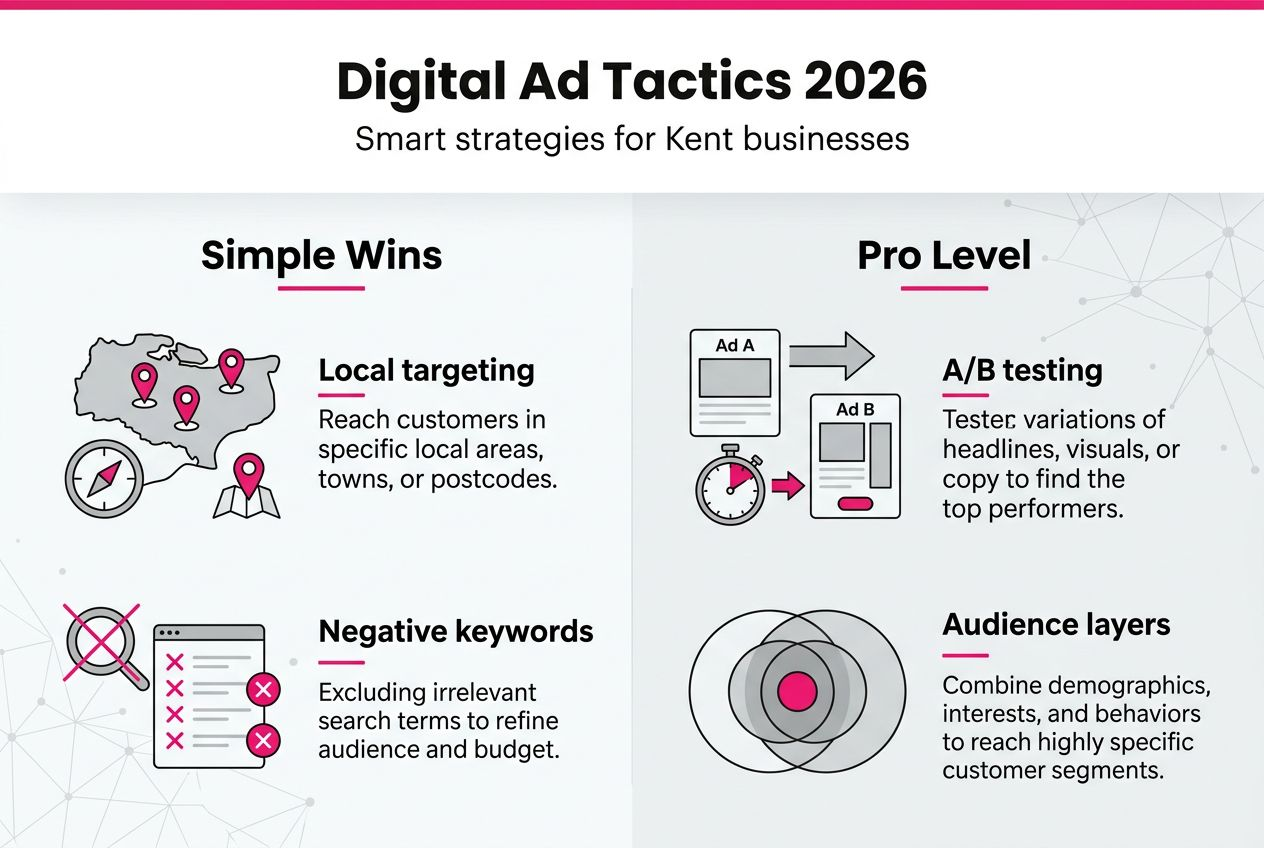
Long-tail keywords target specific customer needs with less competition. “Accountant” costs £15 per click and attracts tyre-kickers. “Small business accountant for hospitality Kent” costs £4 per click and reaches business owners ready to hire specialist help. These detailed phrases convert better because they match precise search intent. Build campaigns around problems your ideal customers actually face.
Audience layering combines multiple targeting criteria for precision. Start with location, then add demographics like age or income, then layer behavioural signals like previous website visitors or people who engaged with your content. This stacking creates highly qualified audience segments more likely to convert. A wedding photographer might target engaged women aged 25-35 within 20 miles who visited competitor websites.
A/B testing reveals what resonates with your audience. Test one variable at a time: headline, call-to-action, image, or landing page layout. Run tests until statistical significance emerges, typically requiring 100-200 conversions per variation. Small improvements compound over time. A 15% better click-through rate means 15% more traffic from the same budget.
Integrating digital ads with SEO marketing services and content creates synergy. Ads drive immediate traffic whilst SEO builds long-term organic presence. Use ad data to identify high-converting keywords, then create content targeting those terms. This combination improves brand recognition, as customers see both paid and organic results. The reinforced presence builds trust faster than either channel alone. SEO effectiveness for SMBs compounds when supported by paid visibility.
Programmatic advertising automates display ad placement across thousands of websites. Algorithms analyse user behaviour and serve ads to people matching your customer profile. This approach suits businesses building awareness beyond search engines. Programmatic platforms offer sophisticated targeting options like retargeting website visitors or reaching lookalike audiences similar to your best customers.
Targeting Method | Best For | Limitations |
Location-based | Local businesses, service areas | Cannot distinguish visitor intent |
Keyword targeting | High-intent searches | Misses customers unaware of solutions |
Demographic | Age/income specific products | Broad assumptions about behaviour |
Behavioural | Retargeting, lookalikes | Requires existing customer data |
Interest-based | Awareness campaigns | Lower conversion rates |
Pro Tip: Connect your social media advertising data with search campaign insights to identify which awareness touchpoints lead to high-intent searches later in the customer journey, allowing you to allocate budget more strategically across channels.
Leveraging AI to enhance digital ad strategies in resource-limited Kent businesses
Artificial intelligence levels the playing field for small businesses competing against larger advertisers. AI tools can double ROI by optimising targeting and bidding decisions faster than manual management allows. These capabilities remain accessible even with limited budgets.
AI-driven platforms analyse millions of data points to predict which audiences will convert. Smart bidding adjusts your bids in real-time based on device, location, time of day, and user behaviour. This dynamic optimisation ensures you bid aggressively for valuable clicks whilst conserving budget on lower-probability conversions. The system learns continuously, improving performance as it gathers more data.
Small budgets benefit disproportionately from AI efficiency. A £500 monthly spend managed manually might generate 10 leads. AI optimisation can increase that to 15-20 leads from the same budget by eliminating waste and focusing spend on highest-probability conversions. The percentage improvement matters more than absolute spend.
Audience segmentation powered by machine learning identifies patterns humans miss. AI spots correlations between seemingly unrelated factors like browsing history, weather conditions, and purchase likelihood. These insights create micro-segments that convert at higher rates. Your ads reach the right person at the optimal moment without requiring constant manual adjustments.
Real-time campaign adjustments respond to performance shifts immediately. Traditional management reviews campaigns weekly or monthly. AI reacts within hours to changing conditions like competitor activity, seasonal demand fluctuations, or trending topics. This responsiveness prevents budget waste during underperforming periods and capitalises on unexpected opportunities.
“Implementing AI bid management and audience targeting increased our cost-per-acquisition efficiency by 53% within eight weeks, allowing us to scale lead generation without proportionally increasing ad spend.”
Accessible AI tools for Kent SMBs include:
Google Ads Smart Bidding for automated bid optimisation
Facebook Advantage+ for simplified campaign creation
Microsoft Advertising auto-targeting features
Third-party platforms like Adzooma for cross-channel management
AI SEO services that integrate with paid strategies
Start with platform-native AI features before investing in external tools. Google and Facebook provide robust automation at no additional cost. Test automated bidding on one campaign whilst maintaining manual control on others. Compare results after 30 days, then expand AI usage to successful implementations. Monitor closely during the learning phase, as algorithms require data to optimise effectively.
Discover expert digital marketing support tailored for Kent businesses
Implementing these strategies requires time and expertise many business owners lack. Professional support ensures campaigns launch correctly, optimise continuously, and deliver measurable returns. Tootle Works specialises in helping Kent SMBs navigate digital advertising complexity whilst maintaining budget control.
Our social media management and SEO marketing services in Kent integrate with paid advertising to create cohesive strategies. We handle campaign setup, ongoing optimisation, and detailed reporting so you understand exactly where your investment goes. Transparent communication and flexible contracts mean you maintain control whilst accessing specialist knowledge.
Start with a free website audit to identify opportunities across your digital presence. We analyse your current performance, competitive landscape, and growth potential. This assessment reveals quick wins and long-term strategies tailored to your business goals. Partnering with experienced marketers accelerates results whilst avoiding costly trial-and-error learning.
Frequently asked questions about digital ads for Kent SMBs
How much should I budget for digital ads as a small Kent business?
Start with £300-£500 monthly to gather meaningful data and test different approaches. This amount allows 50-100 clicks in most local markets, enough to identify what works. Scale spending gradually as you prove return on investment rather than committing large budgets upfront.
What are long-tail keywords and why do they matter?
Long-tail keywords are specific, detailed search phrases like “emergency boiler repair Sevenoaks” rather than generic terms like “plumber”. They cost less per click, face less competition, and attract customers with clear intent. This specificity improves conversion rates whilst reducing wasted spend on irrelevant traffic.
How do I track if my digital ads are working?
Install conversion tracking pixels on your website to monitor actions like form submissions, phone calls, or purchases. Set up goals in Google Analytics to attribute revenue to specific campaigns. Review cost-per-acquisition weekly, comparing it against your customer lifetime value to ensure profitability.
Can AI really improve my campaign results?
Yes, AI optimisation typically improves efficiency by 30-50% through better bid management and targeting. Start with platform-native features like Google Smart Bidding, which requires no additional investment. Monitor performance for 30 days, allowing the algorithm time to learn before judging effectiveness.
Should I combine SEO with digital ads for best results?
Absolutely. Paid ads deliver immediate traffic whilst SEO builds sustainable long-term visibility. Use ad campaign data to identify high-converting keywords, then create content targeting those terms organically. The combined presence increases brand recognition and trust, improving results across both channels whilst reducing overall customer acquisition costs.
Recommended

Comments