
How to grow your business online in Kent with marketing
- Adeline Taylor
- Mar 15
- 10 min read

Growing your business online in Kent can feel overwhelming when you’re juggling operations, customer service, and trying to figure out which digital marketing tactics actually work. Many small to medium businesses in the region invest time and budget into online activities without a clear strategy, leading to inconsistent results and wasted resources. This guide provides a practical, step by step approach to digital marketing that delivers measurable growth. You’ll learn how to prepare your business, execute campaigns that drive traffic and conversions, and verify success through data. Real case studies from Kent businesses prove these methods work when applied systematically.
Table of Contents
Key takeaways
Point | Details |
Strategy drives consistency | A documented digital marketing plan ensures your efforts align with business goals and deliver predictable results. |
Multi-channel maximises reach | Combining SEO, PPC, and social media captures customers at different stages of their buying journey. |
Local SEO converts nearby buyers | Optimising for local search captures high intent customers in Kent ready to purchase. |
Data improves campaign performance | Tracking metrics like conversion rates and ROAS helps you refine tactics and increase returns. |
Regular optimisation sustains growth | Quarterly reviews and continuous improvements keep your marketing competitive and effective. |
Understanding the digital marketing landscape in Kent
Many small businesses operate digital marketing without a clear strategy, leading to inconsistent results and frustration. 47% of businesses are doing digital marketing without a defined strategy, which means nearly half of your competitors are making the same mistake. Kent and the South East are home to a large share of SMEs, with 19% of England’s small and medium enterprises based in this region. This concentration creates both opportunity and competition for local businesses trying to stand out online.
Digital marketing offers powerful tools to reach your target audience, but success requires clear objectives and documented plans. Without direction, businesses often spread resources too thin across multiple channels or chase the latest trend without understanding whether it fits their customer profile. Common challenges include managing limited budgets, coordinating activity across platforms like Google, Facebook, and Instagram, and balancing content creation with technical optimisation.
Developing a documented strategy improves lead flow, conversion rates, and customer retention. When you know exactly who you’re targeting, what message resonates, and which channels deliver the best return, you can focus your efforts and budget where they matter most. A strategic approach also makes it easier to measure success and identify what needs adjustment. Consider these essential elements:
Clear business objectives tied to specific marketing outcomes
Defined target audience with documented pain points and buying triggers
Channel selection based on where your customers spend time online
Budget allocation that prioritises high return activities
Performance metrics that track progress towards your goals
“Digital marketing without strategy is just noise. Strategy transforms your efforts into a system that consistently attracts, converts, and retains customers.”
Understanding the best forms of digital marketing for your specific business model helps you avoid wasting time on tactics that don’t fit your audience or goals. A hospitality business in Canterbury needs different tactics than a B2B professional service in Maidstone, even though both operate in Kent.
Preparing your business for online growth: key tools and strategies
Before launching campaigns, you need to lay the groundwork that makes digital marketing effective. Start by identifying your business goals and target audience in Kent and surrounding areas. Are you trying to increase local foot traffic, generate online enquiries, or build brand awareness across the region? Your objectives determine which channels and tactics will deliver the best results.
Set up essential digital marketing tools that provide visibility into performance. Google Analytics tracks website traffic and user behaviour. Google Search Console monitors your search presence and identifies technical issues. SEO plugins like Yoast or Rank Math help optimise content for search engines. A reliable content management system makes it easy to update your website and publish fresh content regularly. These tools form the foundation of data driven decision making.
Conduct keyword research focusing on local intent and buying signals. People searching for “plumber in Tunbridge Wells” or “Kent wedding venue” are ready to buy, making these high value keywords. Meticulous keyword research and landing page optimisation are crucial for user engagement and conversion, as demonstrated by successful Kent businesses. Use tools like Google Keyword Planner, SEMrush, or Ahrefs to identify terms your customers actually use.
Optimise your website for user experience with clear calls to action and fast performance. Visitors should understand what you offer and how to contact you within seconds of landing on your site. Mobile optimisation is critical since almost 80% of local searches lead to purchase. Slow loading pages drive potential customers to competitors, so test your site speed and fix issues that create friction.

Local SEO captures mobile buyers nearby who are ready to purchase. Claim and optimise your Google Business Profile with accurate information, photos, and regular updates. Build citations on local directories and industry specific platforms. Encourage satisfied customers to leave reviews, as positive feedback influences buying decisions and improves local search rankings. Understanding local SEO lead strategies helps you dominate search results in your area.
Plan an integrated marketing approach combining organic SEO, PPC, and social media. Each channel serves different purposes and reaches customers at various stages of their journey. Follow these preparation steps:
Document your ideal customer profile including demographics, pain points, and online behaviour
Audit your current online presence to identify strengths and gaps
Set SMART goals (Specific, Measurable, Achievable, Relevant, Time bound) for each channel
Create a content calendar that aligns with seasonal trends and business objectives
Establish baseline metrics so you can measure improvement over time
Allocate budget based on channel potential and your capacity to manage campaigns
Pro Tip: Start with one or two channels where your audience is most active, then expand as you build expertise and see results. Trying to do everything at once often leads to mediocre performance across all channels.
Preparation element | Purpose | Timeline | Priority |
Keyword research | Identify high value search terms | 1-2 weeks | High |
Website optimisation | Improve user experience and conversion | 2-4 weeks | High |
Analytics setup | Enable performance tracking | 1 week | Critical |
Content planning | Ensure consistent publishing | Ongoing | Medium |
Competitor analysis | Understand market positioning | 1-2 weeks | Medium |
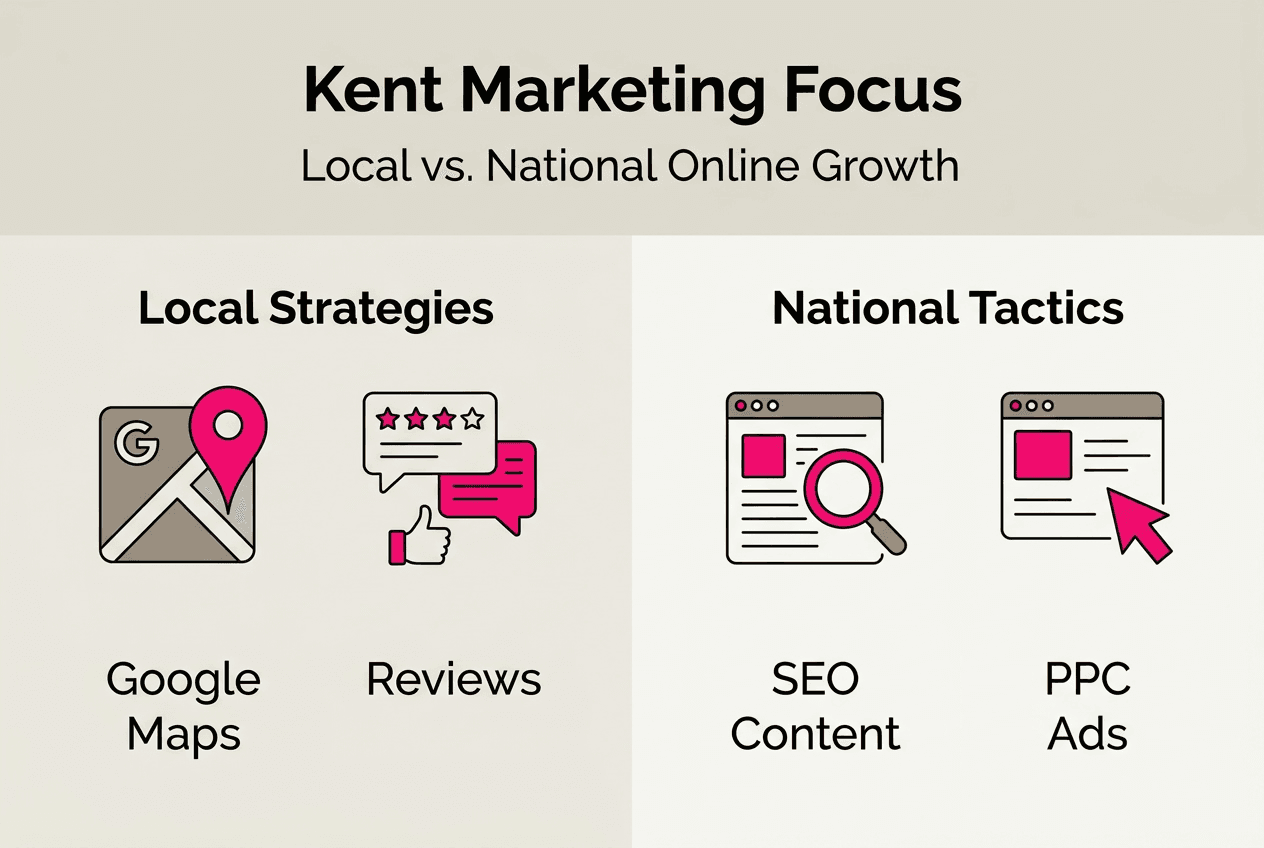
Understanding local vs national marketing strategies helps you decide where to focus your efforts based on your business model and growth objectives. Most Kent SMBs benefit from prioritising local visibility before expanding to national campaigns. Investing time in SEO marketing services fundamentals now creates a foundation that compounds over time.
Executing digital marketing campaigns that drive growth
Once you’ve prepared your business, it’s time to launch campaigns that attract customers and drive revenue. Implement on page and off page SEO focusing on content quality and backlink profiles. On page optimisation includes using target keywords naturally in titles, headings, and body content while maintaining readability. Create content that answers customer questions and solves real problems. Off page SEO involves building authoritative backlinks from relevant websites, which signals to search engines that your site is trustworthy and valuable.
Set up targeted PPC campaigns to maximise conversions and control ad spend effectively. Google Ads allows you to appear at the top of search results for high intent keywords immediately, while organic SEO builds over time. Start with search campaigns targeting bottom of funnel keywords where buyers are ready to take action. Use negative keywords to exclude irrelevant searches and waste less budget. Test different ad copy and landing pages to identify what resonates with your audience.
Use social media marketing to build local brand awareness, engage customers, and promote offers. Choose platforms where your target audience spends time. LinkedIn works well for B2B professional services, while Instagram and Facebook suit hospitality and retail businesses. Post consistently with a mix of educational content, behind the scenes glimpses, and promotional offers. Engage with comments and messages promptly to build relationships.
Combining SEO, Google Ads, and content marketing led to a 441% ROI and a 29.5% revenue increase for MBM Builders Merchants, demonstrating the power of integrated campaigns. When channels work together, they amplify each other’s impact. SEO builds long term visibility while PPC delivers immediate traffic. Social media nurtures relationships that increase brand recall and repeat purchases.
Follow these steps to execute effective campaigns:
Launch SEO optimised content targeting your priority keywords
Set up conversion tracking on your website to measure campaign performance
Create PPC campaigns with tightly themed ad groups and relevant landing pages
Develop a social media posting schedule with varied content types
Monitor campaign performance daily during the first two weeks to catch issues early
Adjust bids, budgets, and targeting based on initial data
Scale successful campaigns gradually while cutting underperformers
Pro Tip: Run small test campaigns before committing large budgets. Testing different messages, audiences, and offers helps you identify winners without risking significant resources.
Channel | Average cost | Primary benefit | Results timeline | Best for |
Local SEO | £500-£2000/month | Long term organic visibility | 3-6 months | Businesses with local customers |
PPC | £800-£3000/month | Immediate targeted traffic | 1-2 weeks | Quick lead generation |
Social media | £300-£1500/month | Brand awareness and engagement | 2-4 months | Building community and loyalty |
Content marketing | £400-£2000/month | Authority and organic reach | 4-8 months | Educating and nurturing buyers |
Understanding the importance of SEO helps you appreciate why it forms the foundation of sustainable online growth. While PPC delivers quick wins, SEO builds an asset that continues generating traffic and leads without ongoing ad spend. Professional social media management ensures consistent posting and engagement even when you’re busy running your business.
Monitor campaigns continuously and optimise based on data. Check which keywords drive the most conversions, not just traffic. Identify which ad copy and landing page combinations produce the lowest cost per acquisition. Track which social posts generate the most engagement and enquiries. Use these insights to refine your approach and improve results over time.
Verifying success and optimising for continuous growth
Tracking performance separates successful digital marketing from random activity. Monitor key metrics like traffic, conversion rates, return on ad spend (ROAS), and customer acquisition cost. Traffic shows how many people you’re reaching, but conversion rate reveals how effectively you turn visitors into customers. ROAS measures how much revenue each pound of ad spend generates, helping you allocate budget to the most profitable channels.
Use analytics tools to identify what’s working and what needs improvement. Google Analytics shows which pages attract visitors and where they drop off in your conversion funnel. Heatmaps reveal how users interact with your website, highlighting confusing navigation or missed calls to action. Campaign tracking parameters let you attribute conversions to specific marketing activities, so you know exactly which efforts drive results.
Avoid random activity and focus on consistent lead flow and protecting conversion rates. Many businesses chase new tactics without optimising existing campaigns, leaving easy wins on the table. Small improvements to conversion rate often deliver bigger returns than doubling traffic. Test different headlines, button colours, form lengths, and page layouts to incrementally improve performance.
Review pricing, user experience, and funnel optimisation to boost revenue and retention. Enhancing user experience and addressing customer challenges can significantly increase conversion rates, as Kent businesses have proven. Sometimes the problem isn’t your marketing but friction in the buying process. Simplify checkout, reduce form fields, offer multiple contact options, and provide clear pricing to remove barriers.
Continuously build your internal link structure to help SEO and guide visitors. Internal links distribute authority across your website and help search engines understand your content hierarchy. They also guide visitors to related information that moves them closer to conversion. Understanding backlink importance for SEO helps you appreciate both internal and external linking strategies.
Implement these verification and optimisation practices:
Review campaign performance weekly to spot trends and issues early
Conduct A/B tests on landing pages, ad copy, and email subject lines
Analyse customer feedback and reviews to identify service improvements
Track competitor activity to maintain your competitive advantage
Document what works so you can replicate success across campaigns
Adjust strategy quarterly based on accumulated data and market changes
“Systematic digital marketing isn’t about luck or guesswork. It’s about testing, measuring, refining, and scaling what works while cutting what doesn’t. This disciplined approach secures measurable returns and sustainable growth.”
Set up automated reporting that delivers key metrics to your inbox weekly or monthly. This keeps performance visible without requiring manual data compilation. Share reports with your team so everyone understands what’s working and where to focus improvement efforts. Celebrate wins and learn from campaigns that underperform.
Don’t expect perfection immediately. Digital marketing improves through iteration. Your first campaign establishes a baseline. Each subsequent campaign should perform better as you apply lessons learned. This continuous improvement mindset separates businesses that achieve sustainable growth from those that plateau after initial gains.
Grow your Kent business with expert digital marketing support
Professional full service digital marketing can help Kent businesses replicate success stories like Kent Express and MBM Builders Merchants, who achieved significant ROI through strategic campaigns. Tootle Works offers tailored strategies including SEO, PPC, and social media management designed specifically for small to medium businesses in Kent. Rather than hiring full time marketing staff, you can outsource your marketing needs to experts who understand the local market and deliver measurable returns.
Working with a digital marketing agency in Kent gives you access to specialists across multiple disciplines without the overhead of building an internal team. The marketing done daily service ensures consistent activity that builds momentum over time, while flexible contracts mean you’re never locked into arrangements that don’t deliver results. Professional SEO marketing services combine technical expertise with content creation to improve your search visibility and attract qualified traffic. Get sustainable growth with ongoing campaign optimisation that adapts to market changes and customer behaviour.
Frequently asked questions
How long does it take to see results from digital marketing?
Digital marketing results typically start appearing within three to six months, depending on your strategy and market competition. SEO builds gradually as search engines index your content and recognise your authority, while PPC can deliver traffic and conversions within days of launching. Social media awareness grows over weeks and months as you build an engaged following.
What budget should I allocate for online marketing?
Budgets vary widely based on your industry, competition, and growth objectives, but most Kent SMBs invest between £1,000 and £5,000 monthly across all channels. Starting with a focused, measurable plan is more important than spending large amounts without direction. Prioritise channels that align with your audience and objectives to maximise ROI, then scale investment as you prove what works.
Is local SEO more important than national marketing for Kent businesses?
Local SEO is essential for capturing nearby customers with high purchase intent, especially for service businesses, retail, hospitality, and professional services. Almost 80% of local searches lead to purchase, making local visibility incredibly valuable. National marketing can expand your reach but typically requires larger budgets and more competitive SEO efforts, so most Kent businesses benefit from dominating local search first.
How often should I update my digital marketing strategy?
Review your strategy at least quarterly to adapt to market changes, seasonal trends, and performance data. Major algorithm updates, competitor activity, or shifts in customer behaviour may require more frequent adjustments. Continuous optimisation of individual campaigns should happen weekly or monthly, but strategic direction typically evolves every three to six months based on accumulated insights and business objectives.
Recommended

Comments